((( Ladies and gentleman, the Pulitzer Prize winners. A newspaper-juried commemoration of well-balanced, well-keeled great American Novels with story arcs and impact crisper than a spiraling pigskin tossed by Eli Manning. I bet any critic who went down the list would enjoy exactly half of them and think the other half were crap. Then we would know that each artist was perfectly in accord with hermself when they wrote these.)))
* 2007: The Road by Cormac McCarthy
* 2006: March by Geraldine Brooks
* 2005: Gilead by Marilynne Robinson
* 2004: The Known World by Edward P. Jones
* 2003: Middlesex by Jeffrey Eugenides
* 2002: Empire Falls by Richard Russo
* 2001: The Amazing Adventures of Kavalier & Clay by Michael Chabon
* 2000: Interpreter of Maladies by Jhumpa Lahiri
* 1999: The Hours by Michael Cunningham
* 1998: American Pastoral by Philip Roth
* 1997: Martin Dressler: The Tale of an American Dreamer by Steven Millhauser
* 1996: Independence Day by Richard Ford
* 1995: The Stone Diaries by Carol Shields
* 1994: The Shipping News by E. Annie Proulx
* 1993: A Good Scent from a Strange Mountain by Robert Olen Butler
* 1992: A Thousand Acres by Jane Smiley
* 1991: Rabbit At Rest by John Updike
* 1990: The Mambo Kings Play Songs of Love by Oscar Hijuelos
* 1989: Breathing Lessons by Anne Tyler
* 1988: Beloved by Toni Morrison
* 1987: A Summons to Memphis by Peter Taylor
* 1986: Lonesome Dove by Larry McMurtry
* 1985: Foreign Affairs by Alison Lurie
* 1984: Ironweed by William Kennedy
* 1983: The Color Purple by Alice Walker
* 1982: Rabbit Is Rich by John Updike
* 1981: A Confederacy of Dunces by John Kennedy Toole
* 1980: The Executioner's Song by Norman Mailer
* 1979: The Stories of John Cheever by John Cheever
* 1978: Elbow Room by James Alan McPherson
* 1977: no award given
* 1976: Humboldt's Gift by Saul Bellow
* 1975: The Killer Angels by Michael Shaara
* 1974: no award given 1
* 1973: The Optimist's Daughter by Eudora Welty
* 1972: Angle of Repose by Wallace Stegner
* 1971: no award given
* 1970: The Collected Stories of Jean Stafford by Jean Stafford
* 1969: House Made of Dawn by N. Scott Momaday
* 1968: The Confessions of Nat Turner by William Styron
* 1967: The Fixer by Bernard Malamud
* 1966: The Collected Stories of Katherine Anne Porter by Katherine Anne Porter
* 1965: The Keepers of the House by Shirley Ann Grau
* 1964: no award given
* 1963: The Reivers by William Faulkner
* 1962: The Edge of Sadness by Edwin O'Connor
* 1961: To Kill a Mockingbird by Harper Lee
* 1960: Advise and Consent by Allen Drury
* 1959: The Travels of Jaimie McPheeters by Robert Lewis Taylor
* 1958: A Death in the Family by James Agee
* 1957: no award given
* 1956: Andersonville by MacKinlay Kantor
* 1955: A Fable by William Faulkner
* 1954: no award given
* 1953: The Old Man and the Sea by Ernest Hemingway
* 1952: The Caine Mutiny by Herman Wouk
* 1951: The Town by Conrad Richter
* 1950: The Way West by A. B. Guthrie, Jr.
* 1949: Guard of Honor by James Gould Cozzens
* 1948: Tales of the South Pacific by James A. Michener
Saturday, February 9, 2008


The Ecstasy of Influence: A Plagiarism
(((Jonathan Lethem's cut-up essay from Harper's gives voice and dynamic insight to the idea of Intellectual Property, literary mixmastering, kicks petulantly at the academic definition of "plagiarism." It's a panaceic unlearning for us lit majors with our modernist critical anxiety stricturing about our noggins. Perhaps googlewriting is motivating us towards a collage method of word assembling i.e. flarfing, and more valid experiments. I predict the cut-up will be king and we'll read history books organized more like "Wisconsin Death Trip" with photos spliced with irrelated newsprint to "enframe" an illogical thematic understanding of a place and era. Meanwhile, novels are just going to keep becoming more and more like novels, poetry more like poetry, and short stories will be printed with movie options attached.)))
((Will TV ever go away? Or will the internet just join it into a corporate-controlled passive entertainment?))
(((Be sure to check out the Appendix at the end which proves this whole thing is true assemblage and that he stole his paradigm shifting pre-teen encounter with William Burroughs' from William Gibson.)))
Link
"
The surrealists believed that objects in the world possess a certain but unspecifiable intensity that had been dulled by everyday use and utility. They meant to reanimate this dormant intensity, to bring their minds once again into close contact with the matter that made up their world. André Breton's maxim “Beautiful as the chance encounter of a sewing machine and an umbrella on an operating table” is an expression of the belief that simply placing objects in an unexpected context reinvigorates their mysterious qualities.
This “crisis” the surrealists identified was being simultaneously diagnosed by others. Martin Heidegger held that the essence of modernity was found in a certain technological orientation he called “enframing.” This tendency encourages us to see the objects in our world only in terms of how they can serve us or be used by us. The task he identified was to find ways to resituate ourselves vis-à-vis these “objects,” so that we may see them as “things” pulled into relief against the ground of their functionality. Heidegger believed that art had the great potential to reveal the “thingness” of objects.
The surrealists understood that photography and cinema could carry out this reanimating process automatically; the process of framing objects in a lens was often enough to create the charge they sought. Describing the effect, Walter Benjamin drew a comparison between the photographic apparatus and Freud's psychoanalytic methods. Just as Freud's theories “isolated and made analyzable things which had heretofore floated along unnoticed in the broad stream of perception,” the photographic apparatus focuses on “hidden details of familiar objects,” revealing “entirely new structural formations of the subject.”
It's worth noting, then, that early in the history of photography a series of judicial decisions could well have changed the course of that art: courts were asked whether the photographer, amateur or professional, required permission before he could capture and print an image. Was the photographer stealing from the person or building whose photograph he shot, pirating something of private and certifiable value? Those early decisions went in favor of the pirates. Just as Walt Disney could take inspiration from Buster Keaton's Steamboat Bill, Jr., the Brothers Grimm, or the existence of real mice, the photographer should be free to capture an image without compensating the source. The world that meets our eye through the lens of a camera was judged to be, with minor exceptions, a sort of public commons, where a cat may look at a king.
Novelists may glance at the stuff of the world too, but we sometimes get called to task for it. For those whose ganglia were formed pre-TV, the mimetic deployment of pop-culture icons seems at best an annoying tic and at worst a dangerous vapidity that compromises fiction's seriousness by dating it out of the Platonic Always, where it ought to reside. In a graduate workshop I briefly passed through, a certain gray eminence tried to convince us that a literary story should always eschew “any feature which serves to date it” because “serious fiction must be Timeless.” When we protested that, in his own well-known work, characters moved about electrically lit rooms, drove cars, and spoke not Anglo-Saxon but postwar English—and further, that fiction he'd himself ratified as great, such as Dickens, was liberally strewn with innately topical, commercial, and timebound references—he impatiently amended his proscription to those explicit references that would date a story in the “frivolous Now.” When pressed, he said of course he meant the “trendy mass-popular-media” reference. Here, transgenerational discourse broke down.
I was born in 1964; I grew up watching Captain Kangaroo, moon landings, zillions of TV ads, the Banana Splits, M*A*S*H, and The Mary Tyler Moore Show. I was born with words in my mouth—“Band-Aid,” “Q-tip,” “Xerox”—object-names as fixed and eternal in my logosphere as “taxicab” and “toothbrush.” The world is a home littered with pop-culture products and their emblems. I also came of age swamped by parodies that stood for originals yet mysterious to me—I knew Monkees before Beatles, Belmondo before Bogart, and “remember” the movie Summer of '42 from a Mad magazine satire, though I've still never seen the film itself. I'm not alone in having been born backward into an incoherent realm of texts, products, and images, the commercial and cultural environment with which we've both supplemented and blotted out our natural world. I can no more claim it as “mine” than the sidewalks and forests of the world, yet I do dwell in it, and for me to stand a chance as either artist or citizen, I'd probably better be permitted to name it. "
((Will TV ever go away? Or will the internet just join it into a corporate-controlled passive entertainment?))
(((Be sure to check out the Appendix at the end which proves this whole thing is true assemblage and that he stole his paradigm shifting pre-teen encounter with William Burroughs' from William Gibson.)))
Link
"
The surrealists believed that objects in the world possess a certain but unspecifiable intensity that had been dulled by everyday use and utility. They meant to reanimate this dormant intensity, to bring their minds once again into close contact with the matter that made up their world. André Breton's maxim “Beautiful as the chance encounter of a sewing machine and an umbrella on an operating table” is an expression of the belief that simply placing objects in an unexpected context reinvigorates their mysterious qualities.
This “crisis” the surrealists identified was being simultaneously diagnosed by others. Martin Heidegger held that the essence of modernity was found in a certain technological orientation he called “enframing.” This tendency encourages us to see the objects in our world only in terms of how they can serve us or be used by us. The task he identified was to find ways to resituate ourselves vis-à-vis these “objects,” so that we may see them as “things” pulled into relief against the ground of their functionality. Heidegger believed that art had the great potential to reveal the “thingness” of objects.
The surrealists understood that photography and cinema could carry out this reanimating process automatically; the process of framing objects in a lens was often enough to create the charge they sought. Describing the effect, Walter Benjamin drew a comparison between the photographic apparatus and Freud's psychoanalytic methods. Just as Freud's theories “isolated and made analyzable things which had heretofore floated along unnoticed in the broad stream of perception,” the photographic apparatus focuses on “hidden details of familiar objects,” revealing “entirely new structural formations of the subject.”
It's worth noting, then, that early in the history of photography a series of judicial decisions could well have changed the course of that art: courts were asked whether the photographer, amateur or professional, required permission before he could capture and print an image. Was the photographer stealing from the person or building whose photograph he shot, pirating something of private and certifiable value? Those early decisions went in favor of the pirates. Just as Walt Disney could take inspiration from Buster Keaton's Steamboat Bill, Jr., the Brothers Grimm, or the existence of real mice, the photographer should be free to capture an image without compensating the source. The world that meets our eye through the lens of a camera was judged to be, with minor exceptions, a sort of public commons, where a cat may look at a king.
Novelists may glance at the stuff of the world too, but we sometimes get called to task for it. For those whose ganglia were formed pre-TV, the mimetic deployment of pop-culture icons seems at best an annoying tic and at worst a dangerous vapidity that compromises fiction's seriousness by dating it out of the Platonic Always, where it ought to reside. In a graduate workshop I briefly passed through, a certain gray eminence tried to convince us that a literary story should always eschew “any feature which serves to date it” because “serious fiction must be Timeless.” When we protested that, in his own well-known work, characters moved about electrically lit rooms, drove cars, and spoke not Anglo-Saxon but postwar English—and further, that fiction he'd himself ratified as great, such as Dickens, was liberally strewn with innately topical, commercial, and timebound references—he impatiently amended his proscription to those explicit references that would date a story in the “frivolous Now.” When pressed, he said of course he meant the “trendy mass-popular-media” reference. Here, transgenerational discourse broke down.
I was born in 1964; I grew up watching Captain Kangaroo, moon landings, zillions of TV ads, the Banana Splits, M*A*S*H, and The Mary Tyler Moore Show. I was born with words in my mouth—“Band-Aid,” “Q-tip,” “Xerox”—object-names as fixed and eternal in my logosphere as “taxicab” and “toothbrush.” The world is a home littered with pop-culture products and their emblems. I also came of age swamped by parodies that stood for originals yet mysterious to me—I knew Monkees before Beatles, Belmondo before Bogart, and “remember” the movie Summer of '42 from a Mad magazine satire, though I've still never seen the film itself. I'm not alone in having been born backward into an incoherent realm of texts, products, and images, the commercial and cultural environment with which we've both supplemented and blotted out our natural world. I can no more claim it as “mine” than the sidewalks and forests of the world, yet I do dwell in it, and for me to stand a chance as either artist or citizen, I'd probably better be permitted to name it. "
Sunday, January 27, 2008
Cock-a-doodle-do in 40 languages
((For some reason I was looking up information on chickens and discovered that the onomatopeia for rooster crowing is sort of 'kukiriku' in most languages. I also discovered that most languages have a literal dual entendre equivalent for "cock"--i.e. a formal word for male rooster which is also slang entendre for the "pecker."--which I guess is also sorta rooster sounding)) From Wikipedia:
"The sound made by the cock is spelled onomatopœically as "cock-a-doodle-do" in English, but otherwise in some other languages, such as: Arabic kookookoo-koo, Bulgarian кукуригу (kukurigu), Catalan Co-co-ro-co, Chinese goh-geh-goh-goh, Croatian ku-ku-ri-ku Czech kykyrikí, Danish kykeliky, Dutch kukeleku, Esperanto kokeriko, Estonian kukeleegu or kikerikii, Faroese kakkulárakó, Filipino Tik-ti-la-ok, Finnish kukkokiekuu, French cocorico, German kikeriki, Greek kikiriku, Gujarati kuk-de-kuk, Hebrew ku-ku-ri-ku, Hindustani kuk-roo-koon or kuk-roo-kroon, Hungarian kukurikú, Indonesian kukuruyuk, Italian chicchirichì, Japanese ko-ke kokkoh, Korean k'ok'iyo, Lithuanian ka-ka-rie-ku, Latvian ki-ke-ri-gū, Norwegian kykkeliky, Persian ququliqu, Polish kukuryku, Portuguese Có có ró có, Romanian cucurigu, Russian ку-ка-ре-ку (ku-ka-rye-ku), Sanskrit काक (kāka), Serbian ku-ku-ri-ku, Slovak kikirikí,Slovene kikiriki, Spanish qui-qui-ri-qui', Swahili KokoRikoo koo, Swedish kuckeliku, Tamil ko-ka-ra-ko, Thai yeki-yeki-yek, Turkish üü-ürü-üüü, Urdu kuk roo kroon, and Vietnamese ò-ó-o-o."
(((I also found a photgraphic print online of what looks to be the fattest, happiest chicken in the world. The print's simply titled "A Buff Wyandotte Chicken with a Bright Red Comb on a Farm in Kansas." Man, it's like these things want to be eaten.)))

"The sound made by the cock is spelled onomatopœically as "cock-a-doodle-do" in English, but otherwise in some other languages, such as: Arabic kookookoo-koo, Bulgarian кукуригу (kukurigu), Catalan Co-co-ro-co, Chinese goh-geh-goh-goh, Croatian ku-ku-ri-ku Czech kykyrikí, Danish kykeliky, Dutch kukeleku, Esperanto kokeriko, Estonian kukeleegu or kikerikii, Faroese kakkulárakó, Filipino Tik-ti-la-ok, Finnish kukkokiekuu, French cocorico, German kikeriki, Greek kikiriku, Gujarati kuk-de-kuk, Hebrew ku-ku-ri-ku, Hindustani kuk-roo-koon or kuk-roo-kroon, Hungarian kukurikú, Indonesian kukuruyuk, Italian chicchirichì, Japanese ko-ke kokkoh, Korean k'ok'iyo, Lithuanian ka-ka-rie-ku, Latvian ki-ke-ri-gū, Norwegian kykkeliky, Persian ququliqu, Polish kukuryku, Portuguese Có có ró có, Romanian cucurigu, Russian ку-ка-ре-ку (ku-ka-rye-ku), Sanskrit काक (kāka), Serbian ku-ku-ri-ku, Slovak kikirikí,Slovene kikiriki, Spanish qui-qui-ri-qui', Swahili KokoRikoo koo, Swedish kuckeliku, Tamil ko-ka-ra-ko, Thai yeki-yeki-yek, Turkish üü-ürü-üüü, Urdu kuk roo kroon, and Vietnamese ò-ó-o-o."
(((I also found a photgraphic print online of what looks to be the fattest, happiest chicken in the world. The print's simply titled "A Buff Wyandotte Chicken with a Bright Red Comb on a Farm in Kansas." Man, it's like these things want to be eaten.)))

Saturday, January 19, 2008
Dramapod, Slipstream, and David Milch
((In the Po-Mo dispersion of semantic form--(a clusterfxck of disjointed image, audio, and text. Sometimes I feel as though multimedia savviness (sic) pressures all simple scribes to feel as though they must evolve into Theraminic Octopi--8 armed, panoptically tonal, digital maestros--to remain relevant) I have found two labels which have been very appealing to me recently.))
Genre: Slipstream. Breaks free of the publishing/Barnes & Noble ghettoization of "Literature" and "Genre fiction."
Medium/Form: AudioDrama Podcasts(((A multimedia production that frees the audience's imagination from the digital age obsession with eyeball kicks. Gracefully free from the didactic, confused hegemony of literate culture in a return to the aural purity of human voice. Music and sound effects, too. Hiply unpretentious in a way that TV, film, and theatre no longer are. A rare instance of a technological advance (podcasting) to enable a return to pre-literate storytelling around a fire.)))
P.S. (((Interesting lecture series by Producer David Milch (Deadwood, John from Cincinnatti) on "The Idea of the Writer." Link)))
Genre: Slipstream. Breaks free of the publishing/Barnes & Noble ghettoization of "Literature" and "Genre fiction."
Medium/Form: AudioDrama Podcasts(((A multimedia production that frees the audience's imagination from the digital age obsession with eyeball kicks. Gracefully free from the didactic, confused hegemony of literate culture in a return to the aural purity of human voice. Music and sound effects, too. Hiply unpretentious in a way that TV, film, and theatre no longer are. A rare instance of a technological advance (podcasting) to enable a return to pre-literate storytelling around a fire.)))
P.S. (((Interesting lecture series by Producer David Milch (Deadwood, John from Cincinnatti) on "The Idea of the Writer." Link)))
Monday, January 14, 2008
Monday evening applesauce
What is ablog? What is a journal? What is a chronicle? How are these fundamentally and semantically different?
What's the fundamental difference between invention and innovation?
I write.
I blog.
I journalize.
I chronicle.
I invent.
I innovate.
Ah, curse this accultured language, it's rigid orthography, and endless jargoning.
"I believe that if it were left to artists to choose their own labels most would choose none."--Ben Shahn
Quote from my acoustic notebook (Blue Mead 5 Star--I've decided it's ultimately preferable to write with a notebook in front of a word processor.)
"The pace of population explosion globally and the advance of technology creates with us a sense that the immediate first decade of the 21st Century is exponentially more relevant than the historically cataclysmic 20th Century where we Post-Did everything, slayed millions, and went to the moon. I'd like sometimes to skip it entirely, reach back to the world my grandfather understood and break past it. hurtling past grandfathers towards Adam. Saxon on fire in a slipstream."
What's the fundamental difference between invention and innovation?
I write.
I blog.
I journalize.
I chronicle.
I invent.
I innovate.
Ah, curse this accultured language, it's rigid orthography, and endless jargoning.
"I believe that if it were left to artists to choose their own labels most would choose none."--Ben Shahn
Quote from my acoustic notebook (Blue Mead 5 Star--I've decided it's ultimately preferable to write with a notebook in front of a word processor.)
"The pace of population explosion globally and the advance of technology creates with us a sense that the immediate first decade of the 21st Century is exponentially more relevant than the historically cataclysmic 20th Century where we Post-Did everything, slayed millions, and went to the moon. I'd like sometimes to skip it entirely, reach back to the world my grandfather understood and break past it. hurtling past grandfathers towards Adam. Saxon on fire in a slipstream."
Saturday, January 12, 2008
JumboShrimp
I'm restarting this blog, dadgummit. A blog updated daily as a 4th dimensional art process. A blog to end all seasons. A blog as a 10 year old literary form, fresh as the novel and that picture-a-day thing that Noah did on Youtube. Not a slur of randomly jumped media. A blog cultivated as a daily eavesdropping of process and thought, not manic fits and starts, tagging metadata as though to build the space shuttle. Yes, yes, I must have this thing.))
Wednesday, December 26, 2007
The Pulitzer Prize
((( Ladies and gentleman, the Pulitzer Prize winners. A newspaper-juried commemoration of well-balanced, well-keeled great American Novels with story arcs and impact crisper than a spiraling pigskin tossed by Eli Manning. I bet any critic who went down the list would enjoy exactly half of them and think the other half were crap. Then we would know that each artist was perfectly in accord with hermself when they wrote these.)))
* 2007: The Road by Cormac McCarthy
* 2006: March by Geraldine Brooks
* 2005: Gilead by Marilynne Robinson
* 2004: The Known World by Edward P. Jones
* 2003: Middlesex by Jeffrey Eugenides
* 2002: Empire Falls by Richard Russo
* 2001: The Amazing Adventures of Kavalier & Clay by Michael Chabon
* 2000: Interpreter of Maladies by Jhumpa Lahiri
* 1999: The Hours by Michael Cunningham
* 1998: American Pastoral by Philip Roth
* 1997: Martin Dressler: The Tale of an American Dreamer by Steven Millhauser
* 1996: Independence Day by Richard Ford
* 1995: The Stone Diaries by Carol Shields
* 1994: The Shipping News by E. Annie Proulx
* 1993: A Good Scent from a Strange Mountain by Robert Olen Butler
* 1992: A Thousand Acres by Jane Smiley
* 1991: Rabbit At Rest by John Updike
* 1990: The Mambo Kings Play Songs of Love by Oscar Hijuelos
* 1989: Breathing Lessons by Anne Tyler
* 1988: Beloved by Toni Morrison
* 1987: A Summons to Memphis by Peter Taylor
* 1986: Lonesome Dove by Larry McMurtry
* 1985: Foreign Affairs by Alison Lurie
* 1984: Ironweed by William Kennedy
* 1983: The Color Purple by Alice Walker
* 1982: Rabbit Is Rich by John Updike
* 1981: A Confederacy of Dunces by John Kennedy Toole
* 1980: The Executioner's Song by Norman Mailer
* 1979: The Stories of John Cheever by John Cheever
* 1978: Elbow Room by James Alan McPherson
* 1977: no award given
* 1976: Humboldt's Gift by Saul Bellow
* 1975: The Killer Angels by Michael Shaara
* 1974: no award given 1
* 1973: The Optimist's Daughter by Eudora Welty
* 1972: Angle of Repose by Wallace Stegner
* 1971: no award given
* 1970: The Collected Stories of Jean Stafford by Jean Stafford
* 1969: House Made of Dawn by N. Scott Momaday
* 1968: The Confessions of Nat Turner by William Styron
* 1967: The Fixer by Bernard Malamud
* 1966: The Collected Stories of Katherine Anne Porter by Katherine Anne Porter
* 1965: The Keepers of the House by Shirley Ann Grau
* 1964: no award given
* 1963: The Reivers by William Faulkner
* 1962: The Edge of Sadness by Edwin O'Connor
* 1961: To Kill a Mockingbird by Harper Lee
* 1960: Advise and Consent by Allen Drury
* 1959: The Travels of Jaimie McPheeters by Robert Lewis Taylor
* 1958: A Death in the Family by James Agee
* 1957: no award given
* 1956: Andersonville by MacKinlay Kantor
* 1955: A Fable by William Faulkner
* 1954: no award given
* 1953: The Old Man and the Sea by Ernest Hemingway
* 1952: The Caine Mutiny by Herman Wouk
* 1951: The Town by Conrad Richter
* 1950: The Way West by A. B. Guthrie, Jr.
* 1949: Guard of Honor by James Gould Cozzens
* 1948: Tales of the South Pacific by James A. Michener
* 2007: The Road by Cormac McCarthy
* 2006: March by Geraldine Brooks
* 2005: Gilead by Marilynne Robinson
* 2004: The Known World by Edward P. Jones
* 2003: Middlesex by Jeffrey Eugenides
* 2002: Empire Falls by Richard Russo
* 2001: The Amazing Adventures of Kavalier & Clay by Michael Chabon
* 2000: Interpreter of Maladies by Jhumpa Lahiri
* 1999: The Hours by Michael Cunningham
* 1998: American Pastoral by Philip Roth
* 1997: Martin Dressler: The Tale of an American Dreamer by Steven Millhauser
* 1996: Independence Day by Richard Ford
* 1995: The Stone Diaries by Carol Shields
* 1994: The Shipping News by E. Annie Proulx
* 1993: A Good Scent from a Strange Mountain by Robert Olen Butler
* 1992: A Thousand Acres by Jane Smiley
* 1991: Rabbit At Rest by John Updike
* 1990: The Mambo Kings Play Songs of Love by Oscar Hijuelos
* 1989: Breathing Lessons by Anne Tyler
* 1988: Beloved by Toni Morrison
* 1987: A Summons to Memphis by Peter Taylor
* 1986: Lonesome Dove by Larry McMurtry
* 1985: Foreign Affairs by Alison Lurie
* 1984: Ironweed by William Kennedy
* 1983: The Color Purple by Alice Walker
* 1982: Rabbit Is Rich by John Updike
* 1981: A Confederacy of Dunces by John Kennedy Toole
* 1980: The Executioner's Song by Norman Mailer
* 1979: The Stories of John Cheever by John Cheever
* 1978: Elbow Room by James Alan McPherson
* 1977: no award given
* 1976: Humboldt's Gift by Saul Bellow
* 1975: The Killer Angels by Michael Shaara
* 1974: no award given 1
* 1973: The Optimist's Daughter by Eudora Welty
* 1972: Angle of Repose by Wallace Stegner
* 1971: no award given
* 1970: The Collected Stories of Jean Stafford by Jean Stafford
* 1969: House Made of Dawn by N. Scott Momaday
* 1968: The Confessions of Nat Turner by William Styron
* 1967: The Fixer by Bernard Malamud
* 1966: The Collected Stories of Katherine Anne Porter by Katherine Anne Porter
* 1965: The Keepers of the House by Shirley Ann Grau
* 1964: no award given
* 1963: The Reivers by William Faulkner
* 1962: The Edge of Sadness by Edwin O'Connor
* 1961: To Kill a Mockingbird by Harper Lee
* 1960: Advise and Consent by Allen Drury
* 1959: The Travels of Jaimie McPheeters by Robert Lewis Taylor
* 1958: A Death in the Family by James Agee
* 1957: no award given
* 1956: Andersonville by MacKinlay Kantor
* 1955: A Fable by William Faulkner
* 1954: no award given
* 1953: The Old Man and the Sea by Ernest Hemingway
* 1952: The Caine Mutiny by Herman Wouk
* 1951: The Town by Conrad Richter
* 1950: The Way West by A. B. Guthrie, Jr.
* 1949: Guard of Honor by James Gould Cozzens
* 1948: Tales of the South Pacific by James A. Michener
Monday, November 12, 2007
Wednesday, November 7, 2007
Friday, October 12, 2007
Lester Bangs
(((If you ask me who I would like to write like, I have to say, "Lester Bangs."
Link
"...I'll admit in front that I have a special affinity for things that don't quite fit into any given demarcated category, partly because I'm one of those perennial misfits myself by choice as well as fate or whatever. By profession, I am categorized as a rock critic. I'll accept that, especially since the whole notion that someone has a 'career' instead of just doing whatever you feel like doing at any given time has always amused me when it didn't make me wanna vomit. O.K., I'm a rock critic. I also write and record music. I write poetry, fiction, straight journalism, unstraight journalism, beatnik drivel, mortifying love letters, death threats to white jazz critics signed 'The Mau Maus of East Harlem,' and once a year my own obituary (latest entry: 'He was promising...'). The point is that I have no idea what kind of a writer I am, except that I do know that I'm good and lots of people read whatever it is I do, and I like it that way." (Lester Bangs, "An Instant Fan's Inspired Notes: You Gotta Listen," 1980)
"...I’m really schizophrenic about that, because on the one hand I would say, yes there is, there’s something inherently, even violent about it, it’s wild and raw and all this. On the other hand, the fact is that ‘Sugar Sugar’ is great Rock 'n' Roll, and there’s nothing rebellious about that at all. I mean that’s right from the belly and heart of capitalism..." (Lester Bangs in 1980 on the rebellious nature of rock 'n' roll. Taken from a 1980 interview)
"What this book demands from a reader is a willingness to accept that the best writer in America could write almost nothing but record reviews." (Greil Marcus, editor of the first Bangs anthology Psychotic Reactions and Carburetor Dung, on the second anthology, Mainlines, Blood Feats and Bad Taste. Taken from the cover of the paperback original.)
"Look at it this way: there are many here among us for whom the life force is best represented by the livid twitching of one tortured nerve, or even a full-scale anxiety attack. I do not subscribe to this point of view 100%, but I understand it, have lived it. Thus the shriek, the caterwaul, the chainsaw gnarlgnashing, the yowl and the whizz that decapitates may be reheard by the adventurous or emotionally damaged as mellifluous bursts of unarguable affirmation." (Lester Bangs, "A Reasonable Guide to Horrible Noise", 1980)
"I'll probably never produce a masterpiece, but so what? I feel I have a Sound aborning, which is my own, and that Sound if erratic is still my greatest pride, because I would rather write like a dancer shaking my ass to boogaloo inside my head, and perhaps reach only readers who like to use books to shake their asses, than to be or write for the man cloistered in a closet somewhere reading Aeschylus while this stupefying world careens crazily past his waxy windows toward its last raving sooty feedback pirouette." (Lester Bangs, "A Quick Trip Through My Adolescence," 1968)
Link
"...I'll admit in front that I have a special affinity for things that don't quite fit into any given demarcated category, partly because I'm one of those perennial misfits myself by choice as well as fate or whatever. By profession, I am categorized as a rock critic. I'll accept that, especially since the whole notion that someone has a 'career' instead of just doing whatever you feel like doing at any given time has always amused me when it didn't make me wanna vomit. O.K., I'm a rock critic. I also write and record music. I write poetry, fiction, straight journalism, unstraight journalism, beatnik drivel, mortifying love letters, death threats to white jazz critics signed 'The Mau Maus of East Harlem,' and once a year my own obituary (latest entry: 'He was promising...'). The point is that I have no idea what kind of a writer I am, except that I do know that I'm good and lots of people read whatever it is I do, and I like it that way." (Lester Bangs, "An Instant Fan's Inspired Notes: You Gotta Listen," 1980)
"...I’m really schizophrenic about that, because on the one hand I would say, yes there is, there’s something inherently, even violent about it, it’s wild and raw and all this. On the other hand, the fact is that ‘Sugar Sugar’ is great Rock 'n' Roll, and there’s nothing rebellious about that at all. I mean that’s right from the belly and heart of capitalism..." (Lester Bangs in 1980 on the rebellious nature of rock 'n' roll. Taken from a 1980 interview)
"What this book demands from a reader is a willingness to accept that the best writer in America could write almost nothing but record reviews." (Greil Marcus, editor of the first Bangs anthology Psychotic Reactions and Carburetor Dung, on the second anthology, Mainlines, Blood Feats and Bad Taste. Taken from the cover of the paperback original.)
"Look at it this way: there are many here among us for whom the life force is best represented by the livid twitching of one tortured nerve, or even a full-scale anxiety attack. I do not subscribe to this point of view 100%, but I understand it, have lived it. Thus the shriek, the caterwaul, the chainsaw gnarlgnashing, the yowl and the whizz that decapitates may be reheard by the adventurous or emotionally damaged as mellifluous bursts of unarguable affirmation." (Lester Bangs, "A Reasonable Guide to Horrible Noise", 1980)
"I'll probably never produce a masterpiece, but so what? I feel I have a Sound aborning, which is my own, and that Sound if erratic is still my greatest pride, because I would rather write like a dancer shaking my ass to boogaloo inside my head, and perhaps reach only readers who like to use books to shake their asses, than to be or write for the man cloistered in a closet somewhere reading Aeschylus while this stupefying world careens crazily past his waxy windows toward its last raving sooty feedback pirouette." (Lester Bangs, "A Quick Trip Through My Adolescence," 1968)
Thursday, October 11, 2007
My favorite band
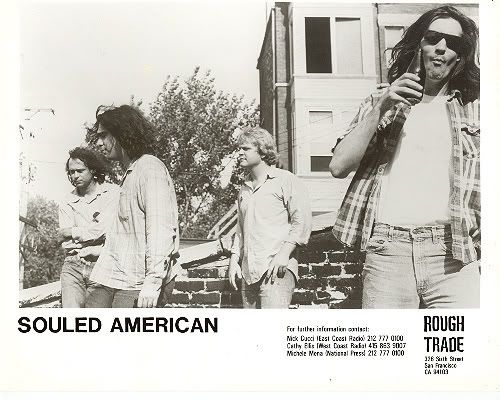
(((If you know Eric Unger and me, you know we love us some Souled American. We've seen them live in Chicago 3 times. This makes us very fortunate people.))
Link
CMYK Magazine


Review of Ian Curtis biopic
((The review claims "Control" is better and less of an inside joke than "24 Hour Party People." I positively heart Joy Division.))))
"Control"
This picture about Joy Division's Ian Curtis is one of the most beautiful movies ever made about rock 'n' roll.
By Stephanie Zacharek Salon, October 10
Link to whole review
"If you're over 30 -- or even if you're not -- you know what happens next: You can't hang onto youth, but you can hang onto music, and so, at least in some small way, most of us do. The trick is to guard against blind nostalgia, to open yourself to the possibility that the music you loved when you were 20 can still mean something when you're 45. Perhaps it can mean even more.
Anton Corbijn's "Control" tells the story of Ian Curtis, the lead singer of the revered Manchester post-punk band Joy Division. Joy Division -- its other members were Bernard Sumner, Peter Hook and Stephen Morris -- made only two albums before Curtis killed himself in 1980, on the eve of the band's first U.S. tour. Before Curtis' death, Joy Division was virtually unknown in the United States, even though their following in the U.K. had been growing steadily. By the time most people stateside started paying attention to them, Curtis was gone. But both his story and the band's music -- darkly glittering songs that sounded majestic rather than self-indulgently world-weary -- were compelling enough to earn Joy Division a passionate following. The fact that the band's surviving members had regrouped as a very different band, New Order, made the saga even more magnetic."
"Control"
This picture about Joy Division's Ian Curtis is one of the most beautiful movies ever made about rock 'n' roll.
By Stephanie Zacharek Salon, October 10
Link to whole review
"If you're over 30 -- or even if you're not -- you know what happens next: You can't hang onto youth, but you can hang onto music, and so, at least in some small way, most of us do. The trick is to guard against blind nostalgia, to open yourself to the possibility that the music you loved when you were 20 can still mean something when you're 45. Perhaps it can mean even more.
Anton Corbijn's "Control" tells the story of Ian Curtis, the lead singer of the revered Manchester post-punk band Joy Division. Joy Division -- its other members were Bernard Sumner, Peter Hook and Stephen Morris -- made only two albums before Curtis killed himself in 1980, on the eve of the band's first U.S. tour. Before Curtis' death, Joy Division was virtually unknown in the United States, even though their following in the U.K. had been growing steadily. By the time most people stateside started paying attention to them, Curtis was gone. But both his story and the band's music -- darkly glittering songs that sounded majestic rather than self-indulgently world-weary -- were compelling enough to earn Joy Division a passionate following. The fact that the band's surviving members had regrouped as a very different band, New Order, made the saga even more magnetic."
The Complexity of Songs
(((Math studies pop music, or vice-versa.)))
Link
"The Complexity of Songs" was an article published by Donald Knuth, an example of an in-joke in computer science, namely, in computational complexity theory. The article capitalizes on the tendency of popular songs to evolve from long and content-rich ballads to highly repetitive texts with little or no meaningful content.
With a grain of truth, Knuth writes that "...our ancient ancestors invented the concept of refrain" to reduce the space complexity of songs, which becomes crucial when a large number of songs is to be committed to one's memory. Knuth's Lemma 1 states that if N is the length of a song, then the refrain decreases the song complexity to cN, where c < 1.
Knuth further demonstrates a way of producing songs with O(\sqrt N) complexity, an approach "...further improved by a Scottish farmer named O. McDonald" (priority disputed).
More ingenious approaches yield songs of complexity O(logN). Finally, progress during the twentieth century—stimulated by the fact that "the advent of modern drugs has led to demands for still less memory"—leads to the ultimate improvement: Arbitrarily long songs with space complexity O(1), e.g. for a song to be defined by the recurrence relation
S_0=\epsilon, S_k = V_kS_{k-1},\, k\ge 1,
Vk = 'That's the way,' U 'I like it,' U, for all k > 0
U = 'uh huh, uh huh'
Link
"The Complexity of Songs" was an article published by Donald Knuth, an example of an in-joke in computer science, namely, in computational complexity theory. The article capitalizes on the tendency of popular songs to evolve from long and content-rich ballads to highly repetitive texts with little or no meaningful content.
With a grain of truth, Knuth writes that "...our ancient ancestors invented the concept of refrain" to reduce the space complexity of songs, which becomes crucial when a large number of songs is to be committed to one's memory. Knuth's Lemma 1 states that if N is the length of a song, then the refrain decreases the song complexity to cN, where c < 1.
Knuth further demonstrates a way of producing songs with O(\sqrt N) complexity, an approach "...further improved by a Scottish farmer named O. McDonald" (priority disputed).
More ingenious approaches yield songs of complexity O(logN). Finally, progress during the twentieth century—stimulated by the fact that "the advent of modern drugs has led to demands for still less memory"—leads to the ultimate improvement: Arbitrarily long songs with space complexity O(1), e.g. for a song to be defined by the recurrence relation
S_0=\epsilon, S_k = V_kS_{k-1},\, k\ge 1,
Vk = 'That's the way,' U 'I like it,' U, for all k > 0
U = 'uh huh, uh huh'
Wednesday, October 10, 2007
Bat for Lashes
(((Let's just sweeten the the somber nature of those last 2 articles articles with that cool Donnie Darko-ish video widna' trick bikes. Happy Hallow'en.)))
Seymour Hersh says we're probably going to invade Iran
(((President Bush is going to try to lame duck a New World Order in his last year.))
Link to entire article
Shifting Targets
The Administration’s plan for Iran.
by Seymour M. Hersh October 8, 2007 New Yorker
"In a series of public statements in recent months, President Bush and members of his Administration have redefined the war in Iraq, to an increasing degree, as a strategic battle between the United States and Iran. “Shia extremists, backed by Iran, are training Iraqis to carry out attacks on our forces and the Iraqi people,” Bush told the national convention of the American Legion in August. “The attacks on our bases and our troops by Iranian-supplied munitions have increased. . . . The Iranian regime must halt these actions. And, until it does, I will take actions necessary to protect our troops.” He then concluded, to applause, “I have authorized our military commanders in Iraq to confront Tehran’s murderous activities.”
Link to entire article
Shifting Targets
The Administration’s plan for Iran.
by Seymour M. Hersh October 8, 2007 New Yorker
"In a series of public statements in recent months, President Bush and members of his Administration have redefined the war in Iraq, to an increasing degree, as a strategic battle between the United States and Iran. “Shia extremists, backed by Iran, are training Iraqis to carry out attacks on our forces and the Iraqi people,” Bush told the national convention of the American Legion in August. “The attacks on our bases and our troops by Iranian-supplied munitions have increased. . . . The Iranian regime must halt these actions. And, until it does, I will take actions necessary to protect our troops.” He then concluded, to applause, “I have authorized our military commanders in Iraq to confront Tehran’s murderous activities.”
Interesting environmental article
(((Salon newsfeeds be stacking up on my doorstep. I don't even know if I like the writer's point or not. It criticizes James Howard Kunstler whom I once saw speak at Bennington. He's a crabby super-cynical fellow; a self-described "gonzo journalist for Rolling Stone in the 70's," and he thinks we should all live in upstate New York. He got up in my grill during the Q&A session.))
Link
Link
Researching the Moneta Theater
((The Moneta theater's reopening its doors this Saturday and I just wrote a small press release on its history. I think I'm stuck on an alliteration kick. Here's what I wrote today, culled from microfiched newspapers. Will someone please edit it? Thanx.)))
"A nearly century-old Sweetwater institution is reopening its doors. (Insert lead paragraph)
In 1915, the census bureau announced that the U.S. population had reached 102 million. Columnist J.C. Jessen of the nationally-syndicated "Motion Picture News" boasted that everyday one in ten of those people attended movie theaters to witness a burgeoning new industry being born on the California coastline. D.W Griffith released the first cinema masterpiece, "Birth of a Nation," which President Woodrow Wilson described as "writing history with lightning." Hardly any town was without a nickelodeon palace located in its center. Sweetwater would be no exception.
In the February of that year Frank Johnston opened the Moneta Theater. Ads promising "photoplays that please" ran in the Sweetwater Telephone alongside ads for castor oil and grippe relief medicine. The theater was an almost immediate success--attendance doubled in the course of its first five months as young and old alike went see the very first romances, horrors, and westerns. "The variety of Comedies and Dramas, will pleasantly relieve tired nerves and better prepare children's minds for study," one ad promised. A 7 year-old debutante, "Little Miss Margaret Bradley," treated her entire Sweetwater primary school class to a "Matinee party" at the the Moneta with movies followed by ice cream at Childress's fountain parlor. The baseball league hosted benefit screenings of "The Rosary."
In the year when Americans and British rallied around the cry, "Remember the Lusitania," the Telephone would implore its readers in a single column blurb each edition to "Remember the Moneta."
"A nearly century-old Sweetwater institution is reopening its doors. (Insert lead paragraph)
In 1915, the census bureau announced that the U.S. population had reached 102 million. Columnist J.C. Jessen of the nationally-syndicated "Motion Picture News" boasted that everyday one in ten of those people attended movie theaters to witness a burgeoning new industry being born on the California coastline. D.W Griffith released the first cinema masterpiece, "Birth of a Nation," which President Woodrow Wilson described as "writing history with lightning." Hardly any town was without a nickelodeon palace located in its center. Sweetwater would be no exception.
In the February of that year Frank Johnston opened the Moneta Theater. Ads promising "photoplays that please" ran in the Sweetwater Telephone alongside ads for castor oil and grippe relief medicine. The theater was an almost immediate success--attendance doubled in the course of its first five months as young and old alike went see the very first romances, horrors, and westerns. "The variety of Comedies and Dramas, will pleasantly relieve tired nerves and better prepare children's minds for study," one ad promised. A 7 year-old debutante, "Little Miss Margaret Bradley," treated her entire Sweetwater primary school class to a "Matinee party" at the the Moneta with movies followed by ice cream at Childress's fountain parlor. The baseball league hosted benefit screenings of "The Rosary."
In the year when Americans and British rallied around the cry, "Remember the Lusitania," the Telephone would implore its readers in a single column blurb each edition to "Remember the Moneta."
I want life to be slow motion
(((The only thing cooler than a water balloon exploding in xtreme slo-motion, is one not exploding.)))
I heart Extreme slow motion
(((First person to create a TV channel that's just this stuff 24-hours-a-day will do quite well))
M.I.A- Bamboo Banga
(((The most danceable track since, "Hey ya?" Perhaps. The only difference: "Hey ya" couln't sustain the ballsout magnitude of its first 45 seconds. "Banmboo Banga" releases increasing steam for about 2 minutes to the point it just couldn't possibly get any better.)))
Weird Bennington Dream

(((I had a dream last night that my old Bennington professor David Slavitt held me down in his class gave me an elegant blue yakuza-style tattoo over my back.)))
((Now that I'm actually reading what I just wrote, it seems pretty weird. Whatever, are your dreams normal?)))
(((Slavitt was seriously the best writing instructor I ever had. A vicious editor. Apparently he ran for local office recently and wrote a book about it.)))
Link
"
What I like most is his on-the-money descriptions of local pols and personalities, and his unique take on the milieu of
(((Benningtonites: Did you ever have a dream at school where the entire campus was in a church-style lock-in inside a gymnasium? I know two other people who used to have that same dream.))))
Tuesday, October 9, 2007
Having the sex and drugs talk with your kids
((This reminds of a Joe Frank radio sketch))
"A few years ago, I took Zachary to a Steely Dan concert in Concord, Calif. He was a month shy of his 15th birthday and had just started high school. We had a fine old time, although as with all these dinosaur-band shows, it was humiliating to look around and see how bad we aging fans all looked. Toward the end of the show, lots of people crowded down into the first few rows and started dancing, and we did too. That was when the guy boogeying next to me offered me a very large joint.
Sex, drugs and my 15-year-old
When I had The Talk with my son, it didn't go quite the way Nancy Reagan drew it up.
By Gary Kamiya
"A few years ago, I took Zachary to a Steely Dan concert in Concord, Calif. He was a month shy of his 15th birthday and had just started high school. We had a fine old time, although as with all these dinosaur-band shows, it was humiliating to look around and see how bad we aging fans all looked. Toward the end of the show, lots of people crowded down into the first few rows and started dancing, and we did too. That was when the guy boogeying next to me offered me a very large joint.
I hesitated. I smoke dope on occasion, but I had never done it in front of Zach before. Was he old enough to handle it? Was it time to end this faintly hypocritical charade of "protecting" him from something I didn't think was dangerous or wrong? Yep. I accepted the joint and took an enormous hit. I glanced at Zachary. He was rocking happily away, but he definitely saw me. The Dan -- who, by a strange coincidence, derive their name from a stainless-steel dildo in a William S. Burroughs novel -- rocked on through another encore or two. The joint came around again and I took another major hit. The band finished their last song and left the stage, and we all began to file out, an inglorious army of balding men in shorts, Tevas and Costco Hawaiian shirts, and soccer moms losing the battle of the bulge.
By the time we had walked the mile or so to the car, I realized that I was extremely stoned. Which probably had something to do with at least part of the conversation that ensued.
"So, Zach," I said as I pulled out of the parking lot, "we should probably talk about drugs. Since you saw me smoke that joint back there."
Some nice orgone accumulators for sale
(((I need to sit in one of these. Straight from Orgonon, Maine.)))
Link
 See whats available now:
3 Ply ORAC
5 Ply ORAC
7 Ply ORAC
10 Ply ORAC
20 Ply ORAC
Orgone Accumulator KITSOrgone accumulating devices are for experimental use only.
They are not medical devices.
If you have a medical problem, please consult a health care professional.
Link
See whats available now:3 Ply ORAC
5 Ply ORAC
7 Ply ORAC
10 Ply ORAC
20 Ply ORAC
Orgone Accumulator KITS
Designed for an individual to sit inside, the orgone accumulator attracts energy from the outside atmosphere, concentrates it on the inside where it comes into contact with the users' energy field and the two fields luminate, creating an even stronger charge. The body easily absorbs this energy as it is the same bio-energy that permeates everything, giving life and vitality: what Wilhelm Reich, it's discoverer, called "orgone energy". Using an orgone energy accumulator will expand your energy field, increasing the amount of energy in all your cells and tissues and improve your immune system; it will melt away stress and impart a feeling of well-being.
The large, sit-in, life energy accumulators are made in an energetically clean environment and from natural, high-quality materials. Much time, care, knowledge, and attention goes into the making of every orgone accumulator.
YOU SHOULD KNOW: Please read the section "WHAT IS ORGONE ENERGY and Who Can Use an Orgone Accumulator" to learn about the restrictions on using an orgone accumulator. People with the following conditions should not use an orgone accumulator device, or only with careful monitoring by a health care professional:
chronic high blood pressure, arteriosclerosis, decompensated heart disease, brain tumors, skin inflammations, conjunctivitis, people who suffer from apoplectic attacks and people with ALS or MS should use caution.
Because orgone energy is "allergic" to strong electromagnetic fields and certain forms of radiation, orgone accumulators should also not be placed near operating CRT TVs, fluorescent lights, CRT computers, microwaves, x-ray equipment, electric heaters, sparking motors, strong fumes, radioactive smoke detectors and within 25 miles of a nuclear power plant. The new flatscreen TVs and computers do not seem to have the disturbing energy fields.
They are not medical devices.
If you have a medical problem, please consult a health care professional.
NYC Gov hosts design an evacuation contest
(((Come on. Design something. Or study it.)))

Link
"Letter from OEM Commissioner
What if New York City were hit by a Category 3 Hurricane?
In New York City, over eight million people live on land that has 578 miles of waterfront. By 2030, the population is expected to reach nine million. At the same time, global climate change has put New York City at an increased risk for a severe coastal storm. In recent years, storms have become more intense, occur more frequently, and continue farther north than they have historically. The city would face many challenges during and after such a storm; one of the most difficult is the possibility that hundreds of thousands of people could lose their homes.
With financial support from the Rockefeller Foundation and in consultation with Architecture for Humanity-New York, the New York City Office of Emergency Management is sponsoring an open competition to generate solutions for post-disaster provisional housing. "What if New York City..." is a call for innovation and an opportunity for designers and policy-makers to collaborate on one of the biggest challenges facing densely settled urban areas after a disaster: how do we keep people safely and comfortably housed while reconstruction proceeds?
A jury of experts in the fields of architecture, design, urbanism, and government will choose ten entrants who will be awarded $10,000 each and technical support to develop their proposals into workable solutions. These solutions will provide support for New York's most vulnerable communities and be a precedent for dense urban areas all over the world.
This design competition will rely on a fictional but realistic New York City neighborhood devastated by a hypothetical Category 3 hurricane. How will residents resume their lives? How can they be provided safe, comfortable living space? How can this housing be quickly deployed and adapted to different site conditions? How can it be reused in subsequent emergencies, environmentally sustainable, and cost effective?
I invite you to dedicate your talents to meet these challenges, in hopes that together we can build a more resilient New York City.
Joseph F. Bruno, OEM Commissioner

Link
"Letter from OEM Commissioner
What if New York City were hit by a Category 3 Hurricane?
In New York City, over eight million people live on land that has 578 miles of waterfront. By 2030, the population is expected to reach nine million. At the same time, global climate change has put New York City at an increased risk for a severe coastal storm. In recent years, storms have become more intense, occur more frequently, and continue farther north than they have historically. The city would face many challenges during and after such a storm; one of the most difficult is the possibility that hundreds of thousands of people could lose their homes.
With financial support from the Rockefeller Foundation and in consultation with Architecture for Humanity-New York, the New York City Office of Emergency Management is sponsoring an open competition to generate solutions for post-disaster provisional housing. "What if New York City..." is a call for innovation and an opportunity for designers and policy-makers to collaborate on one of the biggest challenges facing densely settled urban areas after a disaster: how do we keep people safely and comfortably housed while reconstruction proceeds?
A jury of experts in the fields of architecture, design, urbanism, and government will choose ten entrants who will be awarded $10,000 each and technical support to develop their proposals into workable solutions. These solutions will provide support for New York's most vulnerable communities and be a precedent for dense urban areas all over the world.
This design competition will rely on a fictional but realistic New York City neighborhood devastated by a hypothetical Category 3 hurricane. How will residents resume their lives? How can they be provided safe, comfortable living space? How can this housing be quickly deployed and adapted to different site conditions? How can it be reused in subsequent emergencies, environmentally sustainable, and cost effective?
I invite you to dedicate your talents to meet these challenges, in hopes that together we can build a more resilient New York City.
Joseph F. Bruno, OEM Commissioner

Google adds Chicago to Streetview
(((There are no words to describe how I feel about this google app, right now. I'm impressed and hope dearly google isn't evil.)))
Link
Link
Now here's what they really do.
(((Render people to dust))
The dark truth about Blackwater 
The dark truth about Blackwater
Outsourcing the war to private military contractors such as Blackwater has shattered the United States' moral authority and its ability to win wars like that in Iraq.
By P.W. Singer
Salon.com, Oct. 2, 2007
Photo: Chris Curry/The Virginian-Pilot/ZUMA Press
Blackwater USA Academy recruit Gregory Collier screams to team members during a drill at the Blackwater compound in Moyock, N.C., on Aug. 2, 2006.
Oct. 2, 2007 | WASHINGTON -- On Sept. 16, 2007, a convoy of Blackwater contractors guarding State Department employees entered a crowded square near the Mansour district in Baghdad, Iraq. But versions of what caused the ensuing bloodshed diverge. Employees from the firm claim they were attacked by gunmen and responded within the rules of engagement, fighting their way out of the square after one of their vehicles was disabled. Iraqi police and witnesses instead report that the contractors opened fire first, shooting at a small car driven by a couple with their child that did not get out of the convoy's way as traffic slowed. At some point in the 20-minute gunfight, Iraqi police and army forces stationed in watchtowers above the square also began firing. Other Iraqi security forces and Blackwater quick-reaction forces soon reportedly joined the battle. There are also reports that one Blackwater employee may even have pointed his weapon at his fellow contractors, in an effort to get them to cease firing.
Since then, the Iraqi and U.S. governments have launched separate investigations, likely ensuring that the differing versions of the story will never meet. The only thing agreed upon is the consequences: After a reported 20 Iraqi civilians were killed, including the couple and their child, who was subsequently burned to the mother's body after the car caught fire, the Iraqi government and populace exploded with anger."
---------------------------------------------------------------------------------
"Private military firms -- ranging from well-established companies, such as Vinnell and MPRI, to start-ups, such as the British Aegis -- have played an even greater role in the post-invasion occupation. Halliburton's Kellogg, Brown and Root division, recently spun off into its own firm, currently runs the logistics backbone of the force, doing everything from running military mess halls to moving fuel and ammunition. Other firms are helping to train local forces, including the new Iraqi army and national police.
Then there are the firms such as Blackwater that have played armed roles within the battle space. These firms do everything from helping guard facilities and bases to escorting "high-value" individuals and convoys, arguably the most dangerous job in all of Iraq. Such firms are frequently described as "private security" or "bodyguards," but they are a far cry from rent-a-cops at a local mall, or bodyguards for Hollywood celebrities. They use military training and weaponry to carry out mission-critical functions that would have been done by soldiers in the past, in the midst of a combat zone against fellow combatants. In 2006, the director of the Private Security Company Association of Iraq estimated that just over 48,000 employees from 181 of such "private security companies" were working in Iraq."
--------------------------------------------------------------------------------------
"That is, there was no outcry whenever contractors were called up and deployed, or even killed. If the gradual death toll among American troops threatened to slowly wear down public support, contractor casualties were not counted in official death tolls and had no impact on these ratings. By one count, as of July 2007, more than 1,000 contractors have been killed in Iraq, and another 13,000 wounded. (Again, the data is patchy here, with the only reliable source being insurance claims made by contractors' employers and then reported to the U.S. Department of Labor.) Since the troop "surge" started in January 2007, these numbers have accelerated -- contractors have been killed at a rate of nine per week. These figures mean that the private military industry has suffered more losses in Iraq than the rest of the coalition of allied nations combined. The losses are also far more than any single U.S. Army division has experienced.
Hence, while private losses were just the "cost of doing business" for a firm in Iraq, they actually had an undisguised advantage to policymakers. The public usually didn't even hear about contractor losses, and when they did, they had far less blowback on our government. For all the discussion of contractors as a "private market solution," the true costs that they hope to save are almost always political in nature."
Now this corporation might actually be evil

(((Well, hell, they have an anonymous-looking grey airship. That's kinda evil.))
Link
((A PR-friendly, adjective-laden description of mercenarism. They provide innovative turnkey solutions because they love freedom, peace, and democracy.)
Vision
To support security and peace, and freedom and democracy everywhere."
Mission
Blackwater is committed to supporting national and international security policies that protect those who are defenseless and provide a free voice for all. We dedicate ourselves to providing ethical, efficient, and effective turnkey solutions that positively impact the lives of those still caught in desperate times.
We further are committed to the foot soldiers; the men and women who daily stand on the frontlines of the global war on terror and say, “not today” and who believe in a peaceful future for their communities and nations. Whether they serve in uniform or out, we will provide them the very best in training and tactical support to ensure they are fully prepared to meet current and future global security challenges
"Innovation Begins with Experience
Blackwater Worldwide efficiently and effectively integrates a wide range of resources and core competencies to provide unique and timely solutions that exceed our customers’ stated needs and expectations.
We are guided by integrity, innovation, and a desire for a safer world. Blackwater Worldwide professionals leverage state-of-the-art training facilities, professional program management teams, and innovative manufacturing and production capabilities to deliver world-class, customer-driven solutions.
Our leadership and dedicated family of exceptional employees adheres to an essential of core corporate values- chief among these are integrity, innovation, excellence, respect, accountability, and teamwork."
About Us
"Blackwater was founded in 1997 from a clear vision developed from an understanding of the need for innovative, flexible training and operational solutions to support security and peace, and freedom and democracy everywhere."
"We are not simply a "private security company." We are a professional military, law enforcement, security, peacekeeping, and stability operations firm who provides turnkey solutions. We assist with the development of national and global security policies and military transformation plans. We can train, equip and deploy public safety and military professionals, build live-fire indoor/outdoor ranges, MOUT facilities and shoot houses, create ground and aviation operations and logistics support packages, develop and execute canine solutions for patrol and explosive detection, and can design and build facilities both domestically and in austere environments abroad."
"Blackwater lives its core values of excellence, efficiency, execution, and teamwork. In doing this, we have become the most responsive, cost-effective means of affecting the strategic balance in support of security and peace, and freedom and democracy everywhere."
Core Values
"Excellence: We strive to do not only our best, but to do the best that can be done in all situations and under all circumstances to protect the defenseless and provide a safe environment for all.
Efficiency: We will create the most value using the least amount of resources to achieve the greatest success.
Execution: The foundation of our success. We plan to execute, and execute our plan. Using innovation, flexibility, speed and agility, we will perform with moral courage and conviction and we will do so against all odds.
Teamwork: That which holds everything together. We pool our collective talents to find the optimal solution for our customers and for ourselves. One person can make a difference, but a lot of people make a lot of difference. We will harness the collective energy of Blackwater and direct it toward realizing our vision."
((I assume that by linking to them, I'll get at least one unique reader today. If this blog stops getting updated, it's because I've been "black-bagged." Call Human Rights Watch.)))
Is google actually turning evil?
(((It's 3 a.m. I woke up suddenly and can't sleep because I wondering if the corporation whose motto is "Don't be evil," is in fact, turning evil. Whatever, they sell ads--join the club of the freaking most of us. Not exactly Blackwater.)))
Will Google's Greed Ruin the Internet?
By Jeffrey Chester, The Nation
Posted on October 6, 2007, Printed on October 9, 2007
http://www.alternet.org/story/64214/
Should we be worried about Google? Ten years after the search engine was launched by two Stanford University graduate students, Google has become an empowering force and adopted behavior that has transformed the way we access news and information, shop for goods and services and -- increasingly -- how we engage in politics. Who would have imagined four years ago, that Google and its subsidiary YouTube would co-sponsor debates in which ordinary citizens could directly engage with presidential candidates?
Last week, Google's stock hit an all-time high, on the strength of reports that the company will earn more this year than the $10.6 billion it earned in 2006. But while Google has almost overnight become a trusted source of information for the technologically attuned, few have thought to question the extent to which its success poses threats to both our privacy and our aspirations for the positive potential of the Internet.
Google's dramatic growth is a reflection of its role as the most powerful player in the world of interactive marketing. Ninety-nine percent of Google's annual revenues (according to its 10K filing with the SEC) comes from selling targeted advertising on its search engine, which is driven by a massive consumer data collection system.
Google is far more than the digital incarnation of Madison Avenue in the twenty-first century. It is the engine driving us into a new communications era, in which interactive marketing will significantly shape our lives. The company is aggressively expanding its advertising role, building out a sales team poised to partner with the biggest brand advertisers on the planet. Google is pitching its souped-up interactive advertising system to global corporations so they can better blend marketing messaged into the news, information and entertainment we consume.
Google's message to Madison Avenue, as expressed at the OMMA Expo in New York this week is that its technology can leverage tremendous insights about global consumers of products and information, and can deliver the right interactive marketing messages to consumers at precisely the right moment. Ellen Naughton, Google's director of media platforms, urged advertisers to "fish where the fish are," a reference to the millions of viewers of online video, including YouTube. Naughton was particularly proud of "Green Tea Partay," a Google-sold video ad that has drawn more than 3 million viewers to date on YouTube. It's a cheeky video, in which Smirnoff Vodka marketing messages are subtly integrated into the insistent beat of an preppy California hip-hop routine.
Continue Reading
Will Google's Greed Ruin the Internet?
By Jeffrey Chester, The Nation
Posted on October 6, 2007, Printed on October 9, 2007
http://www.alternet.org/story/64214/
Should we be worried about Google? Ten years after the search engine was launched by two Stanford University graduate students, Google has become an empowering force and adopted behavior that has transformed the way we access news and information, shop for goods and services and -- increasingly -- how we engage in politics. Who would have imagined four years ago, that Google and its subsidiary YouTube would co-sponsor debates in which ordinary citizens could directly engage with presidential candidates?
Last week, Google's stock hit an all-time high, on the strength of reports that the company will earn more this year than the $10.6 billion it earned in 2006. But while Google has almost overnight become a trusted source of information for the technologically attuned, few have thought to question the extent to which its success poses threats to both our privacy and our aspirations for the positive potential of the Internet.
Google's dramatic growth is a reflection of its role as the most powerful player in the world of interactive marketing. Ninety-nine percent of Google's annual revenues (according to its 10K filing with the SEC) comes from selling targeted advertising on its search engine, which is driven by a massive consumer data collection system.
Google is far more than the digital incarnation of Madison Avenue in the twenty-first century. It is the engine driving us into a new communications era, in which interactive marketing will significantly shape our lives. The company is aggressively expanding its advertising role, building out a sales team poised to partner with the biggest brand advertisers on the planet. Google is pitching its souped-up interactive advertising system to global corporations so they can better blend marketing messaged into the news, information and entertainment we consume.
Google's message to Madison Avenue, as expressed at the OMMA Expo in New York this week is that its technology can leverage tremendous insights about global consumers of products and information, and can deliver the right interactive marketing messages to consumers at precisely the right moment. Ellen Naughton, Google's director of media platforms, urged advertisers to "fish where the fish are," a reference to the millions of viewers of online video, including YouTube. Naughton was particularly proud of "Green Tea Partay," a Google-sold video ad that has drawn more than 3 million viewers to date on YouTube. It's a cheeky video, in which Smirnoff Vodka marketing messages are subtly integrated into the insistent beat of an preppy California hip-hop routine.
Continue Reading
Monday, October 8, 2007
Photoblog: Huckleberry Bald
(((Went hiking up to Huckleberry Bald yesterday--5,000 ft high. Balds exist only in the Southern Appalachians and their origins are a mystery. I always heard Indian curse.)))
Link
"In the Appalachian Mountains of the eastern United States, balds are mountain summits or crests covered primarily by a thick layer of native grasses or shrubs occurring in areas where heavy forest growth would be expected.
Balds are found primarily in the Southern Appalachians, where the climate is too warm to support an alpine zone— upper areas where trees fail to grow due to short or non-existent growing seasons— even at the highest elevations.[1] The difference between a treeless summit, such as Mount Washington in New Hampshire, and a bald, such as Gregory Bald in the Great Smoky Mountains, is that a lack of trees is normal for the climatic conditions of the former (i.e., high elevation and colder latitude) but abnormal for the climatic conditions of the latter (high elevation, but warmer latitude). One notable example of what makes southern balds paradoxical can be found at Roan Mountain, where Roan High Knob (el. 6,285 ft/1,915 m) is coated with a dense spruce forest, whereas an adjacent summit, Round Bald (el. 5,826 ft/1,776 m), is almost entirely devoid of trees. Thus, despite having nearly identical climatic conditions (high elevation, warmer latitude), one summit is forested whereas the other is not.
Why some summits are bald and some are not is a mystery, although scientists have come up with several hypotheses (see below)"
Link
"In the Appalachian Mountains of the eastern United States, balds are mountain summits or crests covered primarily by a thick layer of native grasses or shrubs occurring in areas where heavy forest growth would be expected.
Balds are found primarily in the Southern Appalachians, where the climate is too warm to support an alpine zone— upper areas where trees fail to grow due to short or non-existent growing seasons— even at the highest elevations.[1] The difference between a treeless summit, such as Mount Washington in New Hampshire, and a bald, such as Gregory Bald in the Great Smoky Mountains, is that a lack of trees is normal for the climatic conditions of the former (i.e., high elevation and colder latitude) but abnormal for the climatic conditions of the latter (high elevation, but warmer latitude). One notable example of what makes southern balds paradoxical can be found at Roan Mountain, where Roan High Knob (el. 6,285 ft/1,915 m) is coated with a dense spruce forest, whereas an adjacent summit, Round Bald (el. 5,826 ft/1,776 m), is almost entirely devoid of trees. Thus, despite having nearly identical climatic conditions (high elevation, warmer latitude), one summit is forested whereas the other is not.
Why some summits are bald and some are not is a mystery, although scientists have come up with several hypotheses (see below)"
Very Like a whale
(((Posted on BoingBoing today. This is an oil rig 900 meters under the ocean. Pretty boring. Then. . .))
Linkl
Linkl
collective nouns
(((In the mildly amusing department: they have an entire discussion board of these on well.com. Couldn't you just imagine putting your high school English teacher in stitches with these pun bombs?)))
Link
"a banality of Republicans"
"a jitter of (cups of) coffee"
"A blast of dove hunters"
"A huddle of hamsters"
"A quarrel of chickens"
"A mess of neocons"
"A collective of liberals"
"A sprawl of cats"
"A swoon of movie stars"
"a banter of party-goers"
"a tracing of plagiarists"
"an exhaustion of vacuum cleaners"
"a gag of garbage"
"a buttload of underwear"
"a hyperbole of politicians"
Link
"a banality of Republicans"
"a jitter of (cups of) coffee"
"A blast of dove hunters"
"A huddle of hamsters"
"A quarrel of chickens"
"A mess of neocons"
"A collective of liberals"
"A sprawl of cats"
"A swoon of movie stars"
"a banter of party-goers"
"a tracing of plagiarists"
"an exhaustion of vacuum cleaners"
"a gag of garbage"
"a buttload of underwear"
"a hyperbole of politicians"
0.9999. . . = 1?
(((I don't understand why this is and it hurts my brain.)))
Link

Link

In mathematics, the recurring decimal 0.999… , which is also written as 

New Band of Horses album
(((Band of Horses is not a particularly innovative or sublime band in my book, but certainly solid and capable rockers. "The Great Salt Lake" was probably my favorite song of 2006. They also just moved to South Carolina from Seattle. This makes me think there's something going on in S.C. I don't know about)))
Stephen M. Deusner, October 08, 2007
Pitchfork Media
Link
"Following the success of their debut Everything All the Time and the subsequent departure of founding member Mat Brooke, the remaining members of Band of Horses moved from Seattle to Mt. Pleasant, South Carolina, and set to recording their follow-up, Cease to Begin, in Asheville. Thousands of land-locked miles from the Great Salt Lake, this cross-country change of scenery is subtly apparent: If Everything All the Time was a Pacific Northwest indie album with flourishes of country and Southern rock, then Cease to Begin reverses the equation. Putting a different regional spin on their tender-hearted indie rock, however, doesn't change up the sound too much-- the guitars still churn and crest majestically, Bridwell's vocals still echo with grandiose reverb-- but simply creates an atmosphere evocative of something like autumn in a small town."
Stephen M. Deusner, October 08, 2007
Pitchfork Media
Link
"Following the success of their debut Everything All the Time and the subsequent departure of founding member Mat Brooke, the remaining members of Band of Horses moved from Seattle to Mt. Pleasant, South Carolina, and set to recording their follow-up, Cease to Begin, in Asheville. Thousands of land-locked miles from the Great Salt Lake, this cross-country change of scenery is subtly apparent: If Everything All the Time was a Pacific Northwest indie album with flourishes of country and Southern rock, then Cease to Begin reverses the equation. Putting a different regional spin on their tender-hearted indie rock, however, doesn't change up the sound too much-- the guitars still churn and crest majestically, Bridwell's vocals still echo with grandiose reverb-- but simply creates an atmosphere evocative of something like autumn in a small town."
Happy Birthday, Ohno-sensei
(((Kazuo Ohno, the Butoh dancer, turns 101 years old this month. Hopefully, Virginie Marchand will give him another sexy lap dance.)))
Glos Is
((((A literary, artistic, communicative happening in Brooklyn. I just talked to Mr. Daniel Grossman today and apparently things are starting to kick with the thing. Along with displaying the talents of many of my friends, they have one of my college short stories up (The Kenzaburo Oe-inspired "I Fear Gooks Metal), and hopefully will have some more soon--I still edit things I wrote in college. The story's 6 web pages long (I don't know why it couldn't just be one) and you have to click "Next" on the left side of the screen to continue reading. I still look for that link to be on the lower right of the text, but other than that, it's a great site.)))
Link
"If I had the language then, to add my own entry into the "The World of Knowledge" it would have said that the skin is spongy and changing, like a beach at high tide. The body is plastic. The sinews are cantaloupe. We grow ourselves up in fits and starts, and if an object draws too close while we grow, the skin will overtake it, carrying it into the thick layers, the way weeds grew over Grandmother's car after she quit driving--the chrome and cracked vinyl vanishing into the gradual layers of dirt and geology. The body expands, then shrinks, churning up the things absorbed in youth and coughing them up in later years. Thus, all history renders into sweat and defecation. We grow old, our shells harden; become a mixture of wax and stone. Silts clean their way in, dripping deep to the marrow, hollowing out tracks and blooming, years later, when uncovered by one attentive, young scientist."
____________________________________________________________
"In muffled darkness, I imagined a gookworm digging inside my leg with hooks, weaving a fibril sack in between bone and the cantaloupe stuff. My teacher had brought a cocoon into class and we passed it around so that each of us could press the delicate silk to our ears and hear the sound of what seemed like ancient baby teeth inside when we rattled it. Someday it would be a butterfly. Now the cocoon lay dormant in my own leg, inherited from my father, respiring slowly and clicking its new, wet mandibles. It would bide time for years to pass and for my body to grow tough and strange to myself; when I grew so far off the floor that my head would fear my feet. When so much would be asked of me, I would return home at the end of each day, sun-burned and aching, too wasted to do anything but fall half-asleep to the drone of the newsman just talking. It was my curse. Some terrible day, when I was pocked with hair and scars and my breath was like steel wool and rotten beef. On that day the gooks metal would chew its way towards daylight and emerge through the birthmark on my leg."
Link
"If I had the language then, to add my own entry into the "The World of Knowledge" it would have said that the skin is spongy and changing, like a beach at high tide. The body is plastic. The sinews are cantaloupe. We grow ourselves up in fits and starts, and if an object draws too close while we grow, the skin will overtake it, carrying it into the thick layers, the way weeds grew over Grandmother's car after she quit driving--the chrome and cracked vinyl vanishing into the gradual layers of dirt and geology. The body expands, then shrinks, churning up the things absorbed in youth and coughing them up in later years. Thus, all history renders into sweat and defecation. We grow old, our shells harden; become a mixture of wax and stone. Silts clean their way in, dripping deep to the marrow, hollowing out tracks and blooming, years later, when uncovered by one attentive, young scientist."
____________________________________________________________
"In muffled darkness, I imagined a gookworm digging inside my leg with hooks, weaving a fibril sack in between bone and the cantaloupe stuff. My teacher had brought a cocoon into class and we passed it around so that each of us could press the delicate silk to our ears and hear the sound of what seemed like ancient baby teeth inside when we rattled it. Someday it would be a butterfly. Now the cocoon lay dormant in my own leg, inherited from my father, respiring slowly and clicking its new, wet mandibles. It would bide time for years to pass and for my body to grow tough and strange to myself; when I grew so far off the floor that my head would fear my feet. When so much would be asked of me, I would return home at the end of each day, sun-burned and aching, too wasted to do anything but fall half-asleep to the drone of the newsman just talking. It was my curse. Some terrible day, when I was pocked with hair and scars and my breath was like steel wool and rotten beef. On that day the gooks metal would chew its way towards daylight and emerge through the birthmark on my leg."
Panic Attack Day!!
(((Once a month or so, I have a gran mal' panic attack. I can't breathe. I get dizzy. I have a tremendous feeling of hopelessness and despair coupled with racing thoughts of death. Today is that day. Yay.)))
Link
Link
The stifling, deathly heat of Chicago
(((Tragic)))
"Death, Havoc and Heat Mar Chicago Race
New York Times
By MONICA DAVEY
Published: October 8, 2007
Link
CHICAGO, Oct. 7 — As temperatures soared into the upper 80s, hundreds of runners in the Chicago marathon fell ill and at least one died on Sunday, prompting officials here to halt the annual race for the first time in its 30-year history.
As runners set off at 8 a.m., temperatures were in the 70s — warm for a fall day in Chicago but not unheard of — and organizers said they had anticipated a normal race day. But as the morning went on, temperatures kept rising, and calls began pouring in: Some runners were telephoning 911; others were flooding into the 15 aid stations along the course; still more were reporting that there was not enough water or Gatorade or even cups.
By 11:30 a.m., race officials, who were consulting with city fire officials, medical experts and the police, stopped the run, setting off waves of confusion and chaos in some parts of the course.
“It was a tough call,” Carey Pinkowski, the marathon’s longtime director, said Sunday night. “It’s my responsibility to make a decision on people’s health and on public safety. All the indications were that it was only going to get worse.”
More than 300 people were picked up by ambulances along the course, many of them suffering from nausea, heart palpitations and dizziness from the stifling heat, fire officials said. Forty-nine were hospitalized for their illnesses, race officials said, and the rest were treated at race-sponsored aid stations and a medical tent.
“I had no faculties whatsoever,” said Dawn Dowell, who was among the injured, having blacked out at Mile 19. Ms. Dowell, 37, of suburban Wheaton, said she could not provide her address or phone numbers in the minutes after she awoke with an emergency medical technician attaching an IV bag to her arm. Ms. Dowell, who spent two hours in a hospital, said she was running her first marathon.
In the 18th mile, a 35-year-old man collapsed. He was later pronounced dead. The Cook County Medical Examiner’s Office identified him as Chad Schieber, 35, of Midland, Mich.
As runners began falling ill on the course, city authorities sought help from suburban fire departments in case they ran out of ambulances. Fire hydrants were opened, creating an enormous spray along a downtown street. Fifteen city buses, air-conditioned to the coolest levels, were sent out as aid stations."
"Death, Havoc and Heat Mar Chicago Race
New York Times
By MONICA DAVEY
Published: October 8, 2007
Link
CHICAGO, Oct. 7 — As temperatures soared into the upper 80s, hundreds of runners in the Chicago marathon fell ill and at least one died on Sunday, prompting officials here to halt the annual race for the first time in its 30-year history.
As runners set off at 8 a.m., temperatures were in the 70s — warm for a fall day in Chicago but not unheard of — and organizers said they had anticipated a normal race day. But as the morning went on, temperatures kept rising, and calls began pouring in: Some runners were telephoning 911; others were flooding into the 15 aid stations along the course; still more were reporting that there was not enough water or Gatorade or even cups.
By 11:30 a.m., race officials, who were consulting with city fire officials, medical experts and the police, stopped the run, setting off waves of confusion and chaos in some parts of the course.
“It was a tough call,” Carey Pinkowski, the marathon’s longtime director, said Sunday night. “It’s my responsibility to make a decision on people’s health and on public safety. All the indications were that it was only going to get worse.”
More than 300 people were picked up by ambulances along the course, many of them suffering from nausea, heart palpitations and dizziness from the stifling heat, fire officials said. Forty-nine were hospitalized for their illnesses, race officials said, and the rest were treated at race-sponsored aid stations and a medical tent.
“I had no faculties whatsoever,” said Dawn Dowell, who was among the injured, having blacked out at Mile 19. Ms. Dowell, 37, of suburban Wheaton, said she could not provide her address or phone numbers in the minutes after she awoke with an emergency medical technician attaching an IV bag to her arm. Ms. Dowell, who spent two hours in a hospital, said she was running her first marathon.
In the 18th mile, a 35-year-old man collapsed. He was later pronounced dead. The Cook County Medical Examiner’s Office identified him as Chad Schieber, 35, of Midland, Mich.
As runners began falling ill on the course, city authorities sought help from suburban fire departments in case they ran out of ambulances. Fire hydrants were opened, creating an enormous spray along a downtown street. Fifteen city buses, air-conditioned to the coolest levels, were sent out as aid stations."
Sunday, October 7, 2007
The enriching downbeat noise of Chicago
((((Good Stuff House is the name of a rather anonymous sushi restaurant in the Irving Park neighborhood of Chicago. It's also the name of a really amazing collaboration between Scott Tuma of Souled American and the Matt Christensen and Mike Weiss of Zelienople. You can listen to some free tracks here, but you have to be really cool like me to own their album. Seriously, I had to beg their bassist personally.))))
Still can't read "Howl" on the radio.
(((At what point in global history, can we look back and say with certainty, "Well, censorship was totally justified in that situation?" I wish this station would be a little more radical in their treatment of it.)))
From Boing-Boing
Public radio station in NYC won't air "Howl" for fear of the FCC
"The FCC's war on dirty words is having a chilling effect -- even WBAI Pacifica, the radical radio station in NYC, is scared of airing Allen Ginsberg's magnificent poem, Howl. "Why, 50 years later after a judge ruled that children could read this poem, people are afraid the courts will say that their ears shouldn't hear it," said Ron Collins, a constitutional law instructor and First Amendment advocate who is leading a small group of authors, broadcasters and free-speech advocates pushing to broadcast the poem eventually. "Yet they can go on the Internet and see far, far worse things."
 Another irony: WBAI, the Pacifica Foundation station in New York that plans to post "Howl" online, is the same station that took on the FCC more than 30 years ago over the right to air George Carlin's comedy routine featuring the "seven dirty words." The challenge led to a 1978 Supreme Court decision governing what naughty words can be broadcast and when.
Pacifica's attorney for FCC issues, John Crigler, thinks airing "Howl" would be "a great test case" in the current environment. But he understands why WBAI won't broadcast "Howl," even between the hours of 10 p.m. and 6 a.m., the hours the FCC has cordoned off for rougher language.
WBAI program director Bernard White fears that the FCC will fine the station $325,000 for every one of Ginsberg's dirty-word bombs. If each Pacifica station that aired the poem - and possibly repeated it - were to be fined for airing "Howl," it could mean millions of dollars in fines."
Copperhead in the pool
(((I spent the entire summer swimming and wadefishing Citico Creek. Didn't see a single snake. I finally go swimming in a backyard swimming pool and a dang copperhead nearly lands on my shoulder. He was dead coz' of the chlorine, tho.
Good thing. They are more aggressive than the timbler rattler. While rarely fatal, their bites can cause a considerable amount of pain and necrosis if left untreated.))))
Good thing. They are more aggressive than the timbler rattler. While rarely fatal, their bites can cause a considerable amount of pain and necrosis if left untreated.))))
Subscribe to:
Posts (Atom)